

The Scarlet Letter by Nathaniel Hawthorne is a classic novel often read for English class in high school. But what did people of the time think of the book?
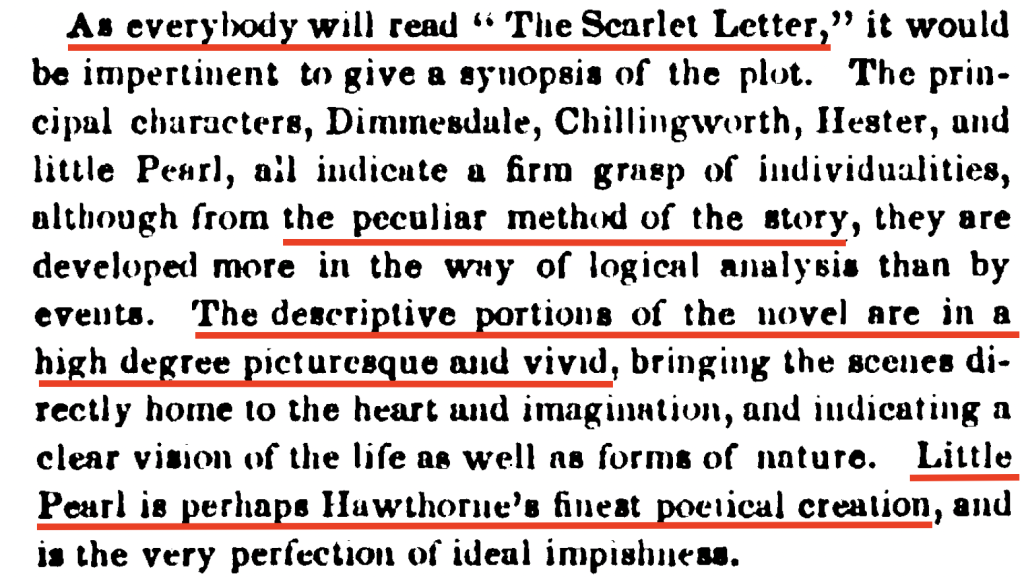
In Graham’s Magazine, Volume 36, No. 5, published in May 1850 (two months after The Scarlet Letter’s publication), a review was published that was highly complimentary. In fact, the word “genius” is used more than once to describe his talent.
Here are some interesting excerpts of what Hawthorne’s contemporaries thought of The Scarlet Letter.
Note: All bolding and underlining is mine.
COMPLIMENTS:
“In this beautiful and touching romance Hawthorne has produced something really worthy of the fine and deep genius which lies within him.”
“It evinces equal genius in the region of great passions and elusive emotions, and bears on every page the evidence of a mind thoroughly alive, watching patiently the movements of morbid hearts when stirred by strange experiences, and piercing, by its imaginative power, directly through all the externals to the core of things.”
CRITIQUE:
“The fault of the book, if fault it have, is the almost morbid intensity with which the characters are realized, and the consequent lack of sufficient geniality in the delineation. A portion of the pain of the author’s own heart is communicated to the reader, and although there is great pleasure received while reading the volume, the general impression left by it is not satisfying to the artistic sense. Beauty bends to power throughout the work, and therefore the power displayed is not always beautiful.”
COMPARISON TO FRENCH NOVELS:
“To another class of readers, those who have theories of seduction and adultery modeled after the French school of novelists, and for whom libertinism is of the brain, the volume may afford matter for very instructive and edifying contemplation; for, in truth, Hawthorne, in The Scarlet Letter, has utterly undermined the whole philosophy on which the French novels rest, by seeing farther and deeper into the essence both of conventional and moral laws; and he has given the results of his insight, not in disquisitions and criticisms, but in representations more powerful even than those of Sue, Dumas, or George Sand. He has made his guilty parties end, not as his own fancy or his own benevolent sympathies might dictate, but as the spiritual laws, lying back of all persons, dictated to him. In this respect there is hardly a novel in English literature more purely objective.”
HOPES FOR HAWTHORNE’S NEXT NOVEL:
“In his next work we hope to have a romance equal to The Scarlet Letter in pathos and power, but more relieved by touches of that beautiful and peculiar humor, so serene and so searching, in which he excels almost all living writers.”
~
Do you agree with this review? Is there anything you disagree with? Thanks for reading, and I hope you found this review interesting!